
Tuesday, 24 November 2020
Sunday, 22 November 2020
A guide for how to start thinking like a leader
Hi!
Whilst I'm certainly no expert and not trying to be some know-it-all here, this was some thing of a cheat sheet I created for up and coming leaders, as part of a development plan to serve as a bit of guidance.
They are a few tried, tested and proven successful items that have worked in mostly all situations and industries, via not only myself but with a few of the leaders I've worked with and developed through the years. You'll probably know and use some (or all) of them already.
If you do see any value, please pass these on to anyone who might be working through any leadership development.
Before getting into the list, the below statement is something I suggest you grab hold of and try to keep to. It will help guide your team through your own actions, and as a prod to yourself.
"EVERYDAY HAS TO BE BETTER THAN AVERAGE"
Whilst it doesn't sound all that inspirational, its enough of a statement to keep you trying, to keep you reaching for something better. Try it, see how it goes for you.
Now the list;
- Have a clear plan on what success looks like for you as a person
- Be passionate / positive – your state of mind will affect your teams state of mind and action
- Be the calm in the eye of any storm – teams need surety and stability to operate effectively during a crisis
- Execute – get stuff done. Finish lines are important.
- Be a constant learner - especially from your people and surroundings. Pay attention to everything.
- The little things for your team mates "DO" matter, often even when they say they don't.
- Create confidence as a leader with your employees
- Be proactive through thought, awareness and action
- Actively collaborate – ensure you involve everyone
- Keep a solid positive connection
- Be transparent where possible – build trust
- Empathy is a genuine super power. It enables the ability to see things "brewing" before they become negative. Empathy also allows you to better connect with your people, vital for when [insert bad word here] hits the fan, and just as important when things are going great
- Don't dismiss your gut instincts – if nothing else, they should be a call for you to be more curious of whatever triggered them.
- Be a clear communicator – what, why, how, when. Especially when dealing with the next point.
- Be good at change management. It is all about ensuring there are no real surprises that frighten, concern or start people making up their own ideas. Lead people in the direction you need to them to be open minded about, or perk their curiosity weeks in advance of any changes you are looking to implement. That way, when the change eventually has to be introduced, it is accepted a lot easier.
- Set strategic goals for yourself and those who report to you – ensure alignment to greater dept. and business goals. Utilise and teach ground level, 2,000 ft., 5,000 ft., 10,000 ft. and 30,000 ft. approaches/thinking to see and deal with potential disruptors and opportunities for success / profit
- Understand how everything "fits" together from dept. to wider business. Where does your business start, what transitions through it (both in and out) and where it finishes
- In relation to point 13, also know where YOU fit in the business, what is the role you play, what can you bring to the team you run, to the depot you work in, to the business as a whole and write them down. This can serve as a reminder on your journey.
- Be curious at all times. Ask all the questions. Better to ask the question, than hide you don't know and end up getting caught out.
- Understand who the key stakeholders of your dept. and business actually are. Meet them.
- Honesty and integrity are a leaders greatest assets. Make these your greatest traits. Instill them in others when teaching / mentoring
- Know you don't have to know everything. A good leader can coach, guide and empower and improve a team's outputs, emotional state, all without being able to do the actual role their team does. Understand how it all works, and ensure you have key people who do the actual work, so they can explain to you any challenges that may affect the team etc that you then address where applicable. This is key to empowering your team. They become the expert in their role.
- Be authentic – it is better to be yourself than pretend to be someone you are not. You can adapt and learn and change, but YOU stays the same. Understand who YOU are.
- Ikigai [google it] and WHY journeys are important
- Understand what the business expects of you and those you lead. When unsure, ask. When no guidance, refer to points 1, 9, 10 and 12
- Treat all people with respect, from the CEO to the cleaner of the toilets. Everyone has a story, everyone has dreams, and everyone has opinions and suggestions. You only have to ask them and be curious. Some of the greatest cost savings and innovations for businesses have come from the lowest ranked person in organisations.
- Develop strong people systems
- Develop and clarify strong process systems
- Be innovative. Drive innovation from within your teams.
- Do what you say you're going to do.
- Frustration and anger are not tools of an effective leader – teams need consistency in emotional content and throughout business
- In conjunction with point 21, it is important to be seen as human. Wherever possible, humanise yourself. Share about your personal life, tell people about your story, be okay with showing vulnerability – these are the things that will endear you to your team, create trusting bonds and long lasting solid professional relationships
So there are a few solid ones to begin with. I deliberately left it at "27" to make you uncomfortable enough to get to "30"...
Give it a shot and add in your own ones and share in the comments section below.
In the meantime, have a great day and a great journey :)
Darren

Thursday, 4 April 2019
Team Dysfunction - hints and tips for both leaders and team members
Hi you!
Great to see you back. How has your week been?
A tricky subject because dysfunction can be obvious and subtle.
This post is in no way trying to be confronting like I have all the answers, because I don't. These are simply a few things I have been taught and thought a good idea to share. As always with these posts, take out of it what you find useful, dismiss what is not. I'm by no means an expert and the aim has always been to offer up my own learnings to promote sharing and empowerment.
Feel free to add in your own thoughts or suggestions in the comments below.
So this is specifically in relation to teams that somehow lose their way, get caught up in frustrations from small issues which then eventually become near impossible impassable mountains.
Team dysfunction almost always increases individual anxiety, pushes up absenteeism, creates friction, causes collective stress (and often perception changes of how an entire team "views" things) and generally lessens the team's effectiveness in working towards their common goal. Bottom line - it can affect a teams reason for existing. More often than not, workloads go from "coping" to "impossible", even without actual workloads actually increasing. Again, its that perception thing.
I've been very lucky in my working career to have worked with a great many teams and individuals. I've run high performance teams, varying levels of dysfunctional ones, right through to supposedly "broken" teams, those of which, thankfully didn't remain that way for long.
But how did I turn the two latter types around? No, I'm not the worlds greatest manager. I just employed some awareness and realised a few home truths, things I have been taught.
Keep reading.
The truth of the matter you need to realise is, there is no team that is ever broken or beyond repair. Same goes for every individual within it. Sure, some people may be unsuited to their roles, choose to move one, be let go or be encouraged to go elsewhere (as is the nature of business) but the main key is to realise that in the majority of situations;
There are always other factors that prevent individuals from being positive members of their team.
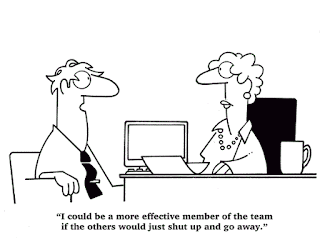 Realising these key features (for both you as a team member or as the leader) can certainly help how the team progresses from that point on. Being aware there is dysfunction is half the battle.
The next key feature relates to the below picture - taken from works by "The Table Group's CEO, Patrick Lencioni - click http://www.tablegroup.com/ to learn more.
 If you are the leader of the team, in my experience it has always been vital to work on repairing each of these 5 dysfunctions via working both one on one with the team members and as the entire group themselves (so everyone hears the same thing, a consistent message from you).
Just as important, if you are the team member, it is your job to be aware of the dysfunction and work on addressing each of the issues for yourself within your team, as a part of it.
For instance with your new awareness of any dysfunction, you have to take some responsibility too and look at yourself. A team is only ever as strong as its members, right? What if you're inadvertently adding to the dysfunction?
As a leader or member of the team, a good thing to try - ask yourself, are you (perceived or actually) any of the following people?

If you are, then the time has arrived to do something about it. You didn't come to work to cause others problems did you? I'm betting you said no, of course not. The trick will be if you can be honest enough with yourself to answer accurately.
If you have been perceived as being The Arrogant, start being more empathetic, try to understand the challenges your fellow team mates are experiencing. Empathy is something I cover often in high performing teams as this can often be lost in the pursuit of better measurements. It is a solid method of seeing something from someone else's perspective. It can also change your own.
If you're The Confused, make a list of the things you're confused about and get the answers you need. It's amazing how knowledge can deal with confusion. So many people dig themselves holes by not fronting up to say they dont understand something. Ask yourself a question - which is better? To know how? Or to pretend you know how? You get the drift.
If you're The Panic Machine, try and figure out why you feel this way all the time. A good tip is to deal in facts and logic more often than dealing with emotions. Emotions are good, but if they're causing you to panic with knee-jerk reactions, go with logic and facts about what is "actually" happening, not what you're afraid "might" be.
Consider this - if I tell you "dont think of a purple elephant". Read that again. What did you do? You thought of a purple elephant, right? This proves hacking your brain is possible. Find your purple elephant.
The Blamer - is nothing ever your fault? Are you absolutely sure about that? Not taking responsibility for your actions or your part in actions is detrimental to any team make-up. Likewise, if you are the leader and The Blamer, then you are creating a culture of fear within your group. This behaviour from a leader creates all five of these types. Like the arrogant one, employ some empathy and look around as to how people are reacting to you. You might be surprised.
The Fearful. Ok, you, my friend, need to have more faith in yourself. Helps to know that fear often comes from a combo of confusion and panic that occurs in situations you think/feel you are ill-prepared for. Worst case scenario feelings. History can also be an influence on you too. My best advice is to read some of my other posts or google up what you can do. All you need is a little bit of self-belief, ensure you have an accurate picture of yourself and to develop some trust so you can ask the questions for the answers you need to feel better. And trust me. You can do it, the world wont end if you admit your fears.
You may also be one of each of the types at different times of the day, week, month or year. Is there a trend you can see? Do you always become the Panic Machine every time you deal with a particular person? Or Blamer when dealing with someone else? Either way, being aware is again, half the battle won.
As the leader of the team and you have these people within your team, it is always your responsibility to help them/facilitate the changes these people will eventually want to strive for under your guidance. By helping, you can address the 5 dysfunctions of a team as represented in the pyramid.
But most of all, remember, no team is ever broken. Some do lose their way at times but believe me, success is never as far away as you might feel it is in the beginning when you realise something might be up.
This post only just scratches the surface of what's possible, like I said, I'm no expert. I make plenty of mistakes, and I'm still learning. This is simply stuff I've been shown and taught in the past and is tried and tested - it works.
Yes, it will take effort and yes, it will take time and yes again, you may make mistakes too, but the thing is, if you are the leader of a team that is struggling, it is 100% your responsibility to help them resolve the issues as best you can. You have to try. You were put into your position as a leader for a reason. Back yourself like you've been backed, get advice if you need it, and get in there.
The effort now will save you time in the future. 100% guarantee.
Likewise, if you are the member of a team that isn't running right, you have a responsibility to help it too. Look at yourself, look at those around you. You already know everyone would prefer to be happier, right? And since you're all in this together, doesn't it make sense to do something about it? Consider the alternative. What if no one does anything? Your team will become even more miserable, some people will leave, your team may collapse entirely.
I sincerely hope some of this has helped you. If you have any questions or even just some clarity around some of the points, please don't hesitate to ask. If I don't have the answers, I'll find some.
Have a great day.

A tricky subject because dysfunction can be obvious and subtle.
This post is in no way trying to be confronting like I have all the answers, because I don't. These are simply a few things I have been taught and thought a good idea to share. As always with these posts, take out of it what you find useful, dismiss what is not. I'm by no means an expert and the aim has always been to offer up my own learnings to promote sharing and empowerment.
Feel free to add in your own thoughts or suggestions in the comments below.
So this is specifically in relation to teams that somehow lose their way, get caught up in frustrations from small issues which then eventually become near impossible impassable mountains.
Team dysfunction almost always increases individual anxiety, pushes up absenteeism, creates friction, causes collective stress (and often perception changes of how an entire team "views" things) and generally lessens the team's effectiveness in working towards their common goal. Bottom line - it can affect a teams reason for existing. More often than not, workloads go from "coping" to "impossible", even without actual workloads actually increasing. Again, its that perception thing.
I've been very lucky in my working career to have worked with a great many teams and individuals. I've run high performance teams, varying levels of dysfunctional ones, right through to supposedly "broken" teams, those of which, thankfully didn't remain that way for long.
But how did I turn the two latter types around? No, I'm not the worlds greatest manager. I just employed some awareness and realised a few home truths, things I have been taught.
Keep reading.
The truth of the matter you need to realise is, there is no team that is ever broken or beyond repair. Same goes for every individual within it. Sure, some people may be unsuited to their roles, choose to move one, be let go or be encouraged to go elsewhere (as is the nature of business) but the main key is to realise that in the majority of situations;
NO ONE COMES TO WORK TO DO A BAD JOB.
There are always other factors that prevent individuals from being positive members of their team.

The next key feature relates to the below picture - taken from works by "The Table Group's CEO, Patrick Lencioni - click http://www.tablegroup.com/ to learn more.

Just as important, if you are the team member, it is your job to be aware of the dysfunction and work on addressing each of the issues for yourself within your team, as a part of it.
For instance with your new awareness of any dysfunction, you have to take some responsibility too and look at yourself. A team is only ever as strong as its members, right? What if you're inadvertently adding to the dysfunction?
As a leader or member of the team, a good thing to try - ask yourself, are you (perceived or actually) any of the following people?
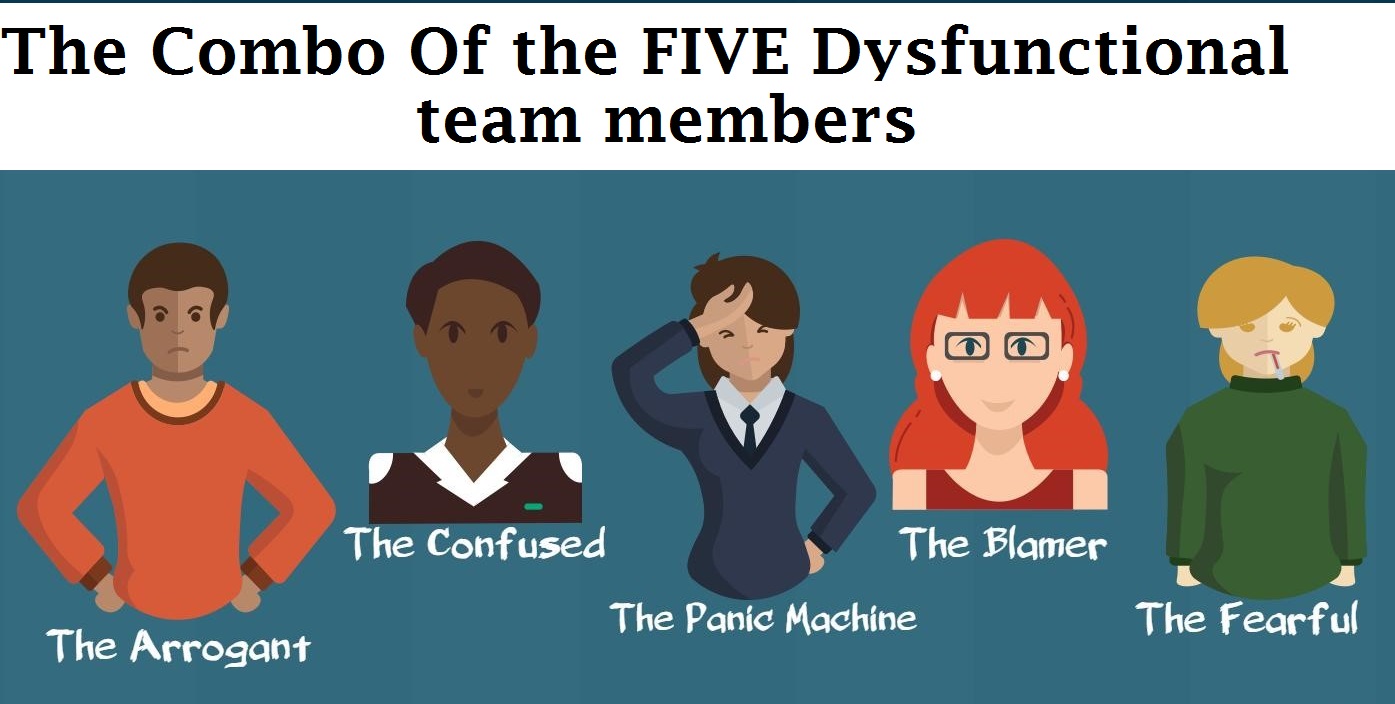
If you have been perceived as being The Arrogant, start being more empathetic, try to understand the challenges your fellow team mates are experiencing. Empathy is something I cover often in high performing teams as this can often be lost in the pursuit of better measurements. It is a solid method of seeing something from someone else's perspective. It can also change your own.
If you're The Confused, make a list of the things you're confused about and get the answers you need. It's amazing how knowledge can deal with confusion. So many people dig themselves holes by not fronting up to say they dont understand something. Ask yourself a question - which is better? To know how? Or to pretend you know how? You get the drift.
If you're The Panic Machine, try and figure out why you feel this way all the time. A good tip is to deal in facts and logic more often than dealing with emotions. Emotions are good, but if they're causing you to panic with knee-jerk reactions, go with logic and facts about what is "actually" happening, not what you're afraid "might" be.
Consider this - if I tell you "dont think of a purple elephant". Read that again. What did you do? You thought of a purple elephant, right? This proves hacking your brain is possible. Find your purple elephant.
The Blamer - is nothing ever your fault? Are you absolutely sure about that? Not taking responsibility for your actions or your part in actions is detrimental to any team make-up. Likewise, if you are the leader and The Blamer, then you are creating a culture of fear within your group. This behaviour from a leader creates all five of these types. Like the arrogant one, employ some empathy and look around as to how people are reacting to you. You might be surprised.
The Fearful. Ok, you, my friend, need to have more faith in yourself. Helps to know that fear often comes from a combo of confusion and panic that occurs in situations you think/feel you are ill-prepared for. Worst case scenario feelings. History can also be an influence on you too. My best advice is to read some of my other posts or google up what you can do. All you need is a little bit of self-belief, ensure you have an accurate picture of yourself and to develop some trust so you can ask the questions for the answers you need to feel better. And trust me. You can do it, the world wont end if you admit your fears.
You may also be one of each of the types at different times of the day, week, month or year. Is there a trend you can see? Do you always become the Panic Machine every time you deal with a particular person? Or Blamer when dealing with someone else? Either way, being aware is again, half the battle won.
As the leader of the team and you have these people within your team, it is always your responsibility to help them/facilitate the changes these people will eventually want to strive for under your guidance. By helping, you can address the 5 dysfunctions of a team as represented in the pyramid.
But most of all, remember, no team is ever broken. Some do lose their way at times but believe me, success is never as far away as you might feel it is in the beginning when you realise something might be up.
AGAIN, NO ONE COMES TO WORK TO DO A BAD JOB.
Once you deal with the barriers causing dysfunction, your team will feel better about themselves as individuals and as a team. Team cohesion will begin, smiles will start being a lot more common, the ability to empower rises up and any historical-type difficulties will be handled by yourself and those around you, almost to the point where the team can self heal from injury.
This post only just scratches the surface of what's possible, like I said, I'm no expert. I make plenty of mistakes, and I'm still learning. This is simply stuff I've been shown and taught in the past and is tried and tested - it works.
Yes, it will take effort and yes, it will take time and yes again, you may make mistakes too, but the thing is, if you are the leader of a team that is struggling, it is 100% your responsibility to help them resolve the issues as best you can. You have to try. You were put into your position as a leader for a reason. Back yourself like you've been backed, get advice if you need it, and get in there.
The effort now will save you time in the future. 100% guarantee.
Likewise, if you are the member of a team that isn't running right, you have a responsibility to help it too. Look at yourself, look at those around you. You already know everyone would prefer to be happier, right? And since you're all in this together, doesn't it make sense to do something about it? Consider the alternative. What if no one does anything? Your team will become even more miserable, some people will leave, your team may collapse entirely.
I sincerely hope some of this has helped you. If you have any questions or even just some clarity around some of the points, please don't hesitate to ask. If I don't have the answers, I'll find some.
Have a great day.

Thursday, 29 November 2018
Wednesday, 19 September 2018
Leadership - what is it all about?
Well...it was inevitable.
Everybody gets older. I turned a year older this very year. I think it likely you did too, or you will.
I know, life. Crazy...
I know, life. Crazy...
For those of you who don't know me. I'm a guy who is still in my forties with a few wrinkles appearing on my face when I smile now, I'm happily married, I have a 17 year old son, a 21 year old daughter, a 3 year old granddaughter and a 9 year old step son. There's a lot more salt than pepper in my beard and hair now than there was a year ago (possible reference to all the children) and I'm less inclined to go for a cross country run now than I was when I was 20.
No wait. Scratch that. I've always hated cross-country running. Face turns red, you sweat and overheat, struggle to breathe, and the constant running thing never tickled my brain. With all those symptoms, I'm pretty sure they're all signs of an allergic reaction.
Plus, running for fun? Have you ever seen a happy runner? No. And there you have it. I do enjoy exercise though, but swimming. Not running. I'm not built to run. I'm more of a stand and see what happens kinda guy.
Plus, running for fun? Have you ever seen a happy runner? No. And there you have it. I do enjoy exercise though, but swimming. Not running. I'm not built to run. I'm more of a stand and see what happens kinda guy.

So let's kick this off. So, how does a guy like me - who did not excel in school but did fine, was not a superstar in any chosen field just fine in most, was not particularly well supported by my teachers due to my incessant curiosity, who came from a single parent home - end up doing all the incredible stuff I have done (and with more to come) across so many businesses and with so many amazing people?
The answer is the very same answer that I've been writing about in almost every single post I've ever written. It all comes down to;
"Attitude"
Yup - this old nugget. "A" double "T", "i" and another "t" with a whole lot of "uuuude" thrown in for good measure.
I - like a lot of the successful people I know - strive each and every day, to focus on the good, to turn not-so-good situations into better, to be proactive greater than 20% of our time and turn the negative thinking of others and ourselves, into more positive views. Dwelling on negatives does no one any good. Learning from negatives becomes a positive and that does everyone good.
By constantly looking for win/win's in every situation, being open to learning from everyone and anyone, by building a genuine, honest rapport with the people you work and interact with, you build a good base with people. Maintaining a constant drive for transparency and integrity in all your dealings, things will often fall into place where they're supposed to. Add to that, doing exactly what you say you're going to do (and striving to become well-known for all these traits), you will build up a size-able level of respect. It's how its worked for me in all the businesses I have worked within.
And judging by the numerous head-hunting messages I get through LinkedIn etc and emails each month, I can only guess that perhaps this respect has translated into word of mouth that I'm a good guy to have on the team too. Always nice to be wanted :D
By constantly looking for win/win's in every situation, being open to learning from everyone and anyone, by building a genuine, honest rapport with the people you work and interact with, you build a good base with people. Maintaining a constant drive for transparency and integrity in all your dealings, things will often fall into place where they're supposed to. Add to that, doing exactly what you say you're going to do (and striving to become well-known for all these traits), you will build up a size-able level of respect. It's how its worked for me in all the businesses I have worked within.
And judging by the numerous head-hunting messages I get through LinkedIn etc and emails each month, I can only guess that perhaps this respect has translated into word of mouth that I'm a good guy to have on the team too. Always nice to be wanted :D
For you reading this, all that effort I've noted might seem a lot or hard work, but it's not. It is just a simple state of mind. Nothing more.
The result of having this type of attitude ensures that you have the opportunity to grow both professionally and personally without burning any bridges along the way. Whilst sure, as a leader you will have to make decisions that ultimately challenge what others are doing and you might get things wrong but in my experience, whatever bridges you "singe", you 'll never burn to the ground. Often the burns will fade once people realise you have not ever deviated from being a genuinely caring person with integrity who they trust. And more often than not, a person's reaction to anything you do, is often reflection on them, rather than you. Especially when you have a good, kind heart with the attitude to match.
And that raises the big point. Being successful in business is never about being heartless. In fact, it's quite the opposite. The people and businesses I have seen become successful, have been all about the heart. Being honest. Valuing people highly. Caring. Whilst there are always dollar decisions to be made, if you have a core set of values of how you view the world and they ultimately reinforce a heart approach and why you're in business in the first place, then you cannot go wrong. And it's easy to see the people and businesses who fall off this path too. You can almost see the disengagement amongst their employees from the moment they suspect they've become numbers rather than human's and their leaders have disengaged.
Whenever you are working, whatever you are doing, if you have the right attitude towards it and those around you, you will succeed. Make sure you're not just sitting back and "expecting" things to happen for (or to) you, and things will get easier and you will keep yourself ahead of the curve. Nice people in business do get somewhere. Nice people with go-get-it attitudes get even further. It does also depend on what you consider is success.
For me, my guide is about making a positive difference to those around me, genuinely helping people develop and grow, building relationships that will stand the test of time, all whilst being well rewarded for my efforts. Not so that I can go buy "stuff", but so that I can provide for my family (be that travel to expand their minds, safer cars they love, healthier food on the table, etc) to the very best of my ability. Your career will take off the moment you define what you want out of one.
The result of having this type of attitude ensures that you have the opportunity to grow both professionally and personally without burning any bridges along the way. Whilst sure, as a leader you will have to make decisions that ultimately challenge what others are doing and you might get things wrong but in my experience, whatever bridges you "singe", you 'll never burn to the ground. Often the burns will fade once people realise you have not ever deviated from being a genuinely caring person with integrity who they trust. And more often than not, a person's reaction to anything you do, is often reflection on them, rather than you. Especially when you have a good, kind heart with the attitude to match.
And that raises the big point. Being successful in business is never about being heartless. In fact, it's quite the opposite. The people and businesses I have seen become successful, have been all about the heart. Being honest. Valuing people highly. Caring. Whilst there are always dollar decisions to be made, if you have a core set of values of how you view the world and they ultimately reinforce a heart approach and why you're in business in the first place, then you cannot go wrong. And it's easy to see the people and businesses who fall off this path too. You can almost see the disengagement amongst their employees from the moment they suspect they've become numbers rather than human's and their leaders have disengaged.
Whenever you are working, whatever you are doing, if you have the right attitude towards it and those around you, you will succeed. Make sure you're not just sitting back and "expecting" things to happen for (or to) you, and things will get easier and you will keep yourself ahead of the curve. Nice people in business do get somewhere. Nice people with go-get-it attitudes get even further. It does also depend on what you consider is success.
For me, my guide is about making a positive difference to those around me, genuinely helping people develop and grow, building relationships that will stand the test of time, all whilst being well rewarded for my efforts. Not so that I can go buy "stuff", but so that I can provide for my family (be that travel to expand their minds, safer cars they love, healthier food on the table, etc) to the very best of my ability. Your career will take off the moment you define what you want out of one.
For the attitude, people will see this great attitude in you, a confidence, a know-where-they-stand understanding and as a result, will not only work hard for and with you, but you will also garner their respect and belief in what you're trying to get done.
Sounds great, right?
But what about all the experience, the skill? What if you're just starting out?
Along with the attitude, you also need to allow yourself to make mistakes, not be too embarrassed to make them so that you then don''t try, become too afraid to ask questions.
You have to be brave.
But what about all the experience, the skill? What if you're just starting out?
Along with the attitude, you also need to allow yourself to make mistakes, not be too embarrassed to make them so that you then don''t try, become too afraid to ask questions.
You have to be brave.
"It's ok to make mistakes"
So many people beat themselves up unnecessarily regarding making mistakes, but ask yourself some logical questions each time you make one;
"What have I learned?"
I'll bet you leaned how NOT to do it again, right? So is that a negative or a positive?
I'll bet you leaned how NOT to do it again, right? So is that a negative or a positive?
"How did that happen in the first place?"
Root cause analysis. Time to start looking at the process and how you got there, which will lead quite nicely into...
Root cause analysis. Time to start looking at the process and how you got there, which will lead quite nicely into...
"How can I stop that happening again?"
Forward thinking to help yourself and others.
Forward thinking to help yourself and others.
"How wide did that mistake go? Who else did it affect?"
This is a good one to consider. Shows caring, plus can open up your mind to stop thinking just about your backyard, this one enables you to think all the way across the business you're in.
Regardless of the mistake, it is absolutely possible to turn it into a "positive" by learning from it and acting on it.
This is a good one to consider. Shows caring, plus can open up your mind to stop thinking just about your backyard, this one enables you to think all the way across the business you're in.
Regardless of the mistake, it is absolutely possible to turn it into a "positive" by learning from it and acting on it.
Did you know about the potential to make this mistake before you made it?
Maybe you did. What actions did you take to ensure it didn't happen? If you didn't, now you do. What will you do with this information you've just learnt?
Will you try to cover it up and fingers crossed no one realises? Well, you could...but where will that get you? Constantly having to hide it? Anxiety that someone might eventually find out? That doesn't sound like any fun now does it. Always better to confess, own any errors you make and spread the word! You don't want anyone else doing the same thing you did, right?
Thing is - your $40 mistake (or even $4000 mistake) that you've just learnt from and are striving to fix/repair etc could be potentially plug a massive dollar hole the business you work for, that no one knew about. You raising it will highlight it. Good trustworthy people spread the word and endeavour to protect the business.
And since you've found the error, by you alerting others to it, your little mistake could potentially save your company millions of dollars in the long run.
So...when you make a mistake, why would you beat yourself up again?
LEARN FROM IT,
ANALYSE IT,
FIX IT,
OWN IT,
SPREAD THE WORD ABOUT IT.
If you need an acronym to remember - try F.O.A.L.S
That's a real positive.
ANALYSE IT,
FIX IT,
OWN IT,
SPREAD THE WORD ABOUT IT.
If you need an acronym to remember - try F.O.A.L.S
That's a real positive.
So give these things a go - consider the environment you work in and look toward upping your personal profile within the business. Think about who you interact with, what your job is, what your role is (job and role can be different) and why you're there.
A few key points to consider too if you want to be well thought of, trusted and successful.
1. Never be a suck-up - everyone can see through sycophantic behaviours, even if you're world class at it. You will effectively lose all respect from the people you work with and miss out on even normal opportunities. No one likes a suck up attention seeker.
2. Keep your cool when others aren't or can't. Someone who can think crystal clear in any crisis is an asset to any business.
3. Never go to a meeting without preparing for it first - you can choose to go as a spectator or a participant. NEVER choose to go as a spectator.
4. Do what you say you're going to do - use outlook calendars, phone reminders etc do whatever you have to make sure you don't forget. If you do forget, don't bother with excuses, own it. You made a mistake. Learn from it.
5. Allow yourself to have fun, and those who report to you. Don't be serious all the time. No one will relate to the person who can't have a laugh. They won't follow you or support any goals you have either.
6. Admit when you don't understand - which would you rather? Know how to do something or do it wrong and have to re-do it?
7. Be genuine/real. This, is numero uno and the MOST important thing of all. Fakes never gain trust. Better to be respected for who you actually are, than respected for someone you're pretending to be.
8. Show empathy for others. Care and concern is a strength, not a weakness. The leader who can empathize, can show vulnerability, is the one people will follow. You "get" them, they "get" you.
9. Proof read every email you send before you send it and re-read every email you receive at least once.
10. And lastly (but by no means finally) - challenge yourself. You're a lot stronger, braver and smarter than you give yourself credit for. Trust that fact and give things a shot. How will you know what you can achieve if you only ever sit back and don't push yourself?
I'll leave this all with you to have a bit of a re-read through - it is a big post.
I sincerely wish you the best of luck with your career. I'm sure you've got this and perhaps all the stuff I've blathered on about, you already knew. If you did, sometimes its just good to have it written down as a reminder. If you didn't, I hope it is helpful.
I sincerely wish you the best of luck with your career. I'm sure you've got this and perhaps all the stuff I've blathered on about, you already knew. If you did, sometimes its just good to have it written down as a reminder. If you didn't, I hope it is helpful.
So please, have a great day...

...and dream big.
Distinguished Gentleman's Ride photoshoot
It's that time of year again!
Where I grab my dapper gear and start telling anyone who will listen about this charity ride I help organise here in Tauranga, and the benefits of why you should donate to this worthy cause.
Please donate :)


Thursday, 29 March 2018
Dealing with problems
So I have been thinking...yeah I know...dangerous times....
But see I've had this thought, a little random thought.
I was on a phone call yesterday, had taken a bite out of an apple whilst on hold (it was a long call). I had plenty of time to finish my mouthful before the person I was talking to came back.
For whatever reason, I kept holding my apple for the entire duration of that phone call, didn't bother putting it down once - and at the end when I hung up, I noticed something.

And this is where I had this thought.
For arguments sake, forget my phone call and let's say I'm holding an apple up in front of your face. Yep, a regular crispy apple.
Now let's say I ask you; "How heavy is this apple?"
You're going to guess.
Maybe anywhere between 100 grams metric or maybe 3-4 ounces if you're from the States.
Now what say, I tell you that no matter how much you determine this apple's weight to be, you will always be wrong - even if you take the apple from me and physically weigh it.
Yes, you're going to think I have lost all my marbles.
So what am I on about?
The thing is, the longer you hold that apple, the sooner you will change how you consider it's weight.
To clarify - if you hold that apple up in front of my face for a minute or two, it wont be a problem - right?
But what if you were to hold that apple up in front of my face for an hour?
Or two hours?
Or maybe two days straight?
The weight of that apple will not physically change but the longer you hold it, the heavier it will get for you.
And here's where that thought has come in, knocking around in my back-brain until it's arrived here.
Could this be some kind of analogy for difficulties we sometimes face?
For those times we negatively prepare for meetings expecting the worst?
For stresses built up only from our own insecurities?
For our anxiety's, our panic's, worries and concerns?
It strikes me that all of these things are all like this apple.
The longer you hold onto them, the more painful they become and the heavier on you they get.

But see I've had this thought, a little random thought.
I was on a phone call yesterday, had taken a bite out of an apple whilst on hold (it was a long call). I had plenty of time to finish my mouthful before the person I was talking to came back.
For whatever reason, I kept holding my apple for the entire duration of that phone call, didn't bother putting it down once - and at the end when I hung up, I noticed something.
And this is where I had this thought.
For arguments sake, forget my phone call and let's say I'm holding an apple up in front of your face. Yep, a regular crispy apple.
Now let's say I ask you; "How heavy is this apple?"
You're going to guess.
Maybe anywhere between 100 grams metric or maybe 3-4 ounces if you're from the States.
Now what say, I tell you that no matter how much you determine this apple's weight to be, you will always be wrong - even if you take the apple from me and physically weigh it.
Yes, you're going to think I have lost all my marbles.
So what am I on about?
The thing is, the longer you hold that apple, the sooner you will change how you consider it's weight.
To clarify - if you hold that apple up in front of my face for a minute or two, it wont be a problem - right?
But what if you were to hold that apple up in front of my face for an hour?
Or two hours?
Or maybe two days straight?
The weight of that apple will not physically change but the longer you hold it, the heavier it will get for you.
And here's where that thought has come in, knocking around in my back-brain until it's arrived here.
Could this be some kind of analogy for difficulties we sometimes face?
For those times we negatively prepare for meetings expecting the worst?
For stresses built up only from our own insecurities?
For our anxiety's, our panic's, worries and concerns?
It strikes me that all of these things are all like this apple.
The longer you hold onto them, the more painful they become and the heavier on you they get.
Goal for you. Please remember to put your apples down.
You'll feel better for it.
Wednesday, 21 February 2018
Effort and failure - why both are good for you and your team
Hi there! Great to see you back.
Today I am running as Captain Obvious. No, nothing to do with lycra or super powers. All the stuff you are about to read, you already know. 100% logical and makes perfect sense.
You ready for the first one? Sure?
...Okay..here we go.
See? You knew this already didn't you? Effort provides reward. More effort, more reward. If you do nothing, nothing changes. Now for the second one. Please take a look at the picture below.

This message is a simple one and again, one you've known all of your life.
No one just becomes a master, an expert or even something more than what they were, without the positive benefits of failure. Yes, you read that right. The POSITIVE benefits of failure.
No one just becomes a master, an expert or even something more than what they were, without the positive benefits of failure. Yes, you read that right. The POSITIVE benefits of failure.
Let's look at the facts and the combo of both statements.
"You only get out, what you put in" and "the positive benefits of failure"
We all start out as beginners, amateurs and newbies in everything we do. Combine this with the first fact - effort - and it is in failure that we learn how to do better as it is one of the most efficient methods of learning.
By trying something, we often fail at it first. If we don't try, not only do we never fail, but we also never grow, improve, or even learn. Failure is something we experience from birth onward. The trick is to view it more positively than negatively.
By trying something, we often fail at it first. If we don't try, not only do we never fail, but we also never grow, improve, or even learn. Failure is something we experience from birth onward. The trick is to view it more positively than negatively.
For every failure where you put in effort, you get to choose what to do with it.
Above the line thinkers learn from it and aim to never make the same mistake again, they gain experience and grow.
Below the line thinkers ignore the lessons and potentially screw up the exact same way later down the track, plus they often avoid the chance to make any more mistakes.
 The vast majority of you reading this will be identifying with more above the line than below. But there have been times where you fell below the line, right? That's okay too. Most everyone does from time to time.
Above the line thinkers learn from it and aim to never make the same mistake again, they gain experience and grow.
Below the line thinkers ignore the lessons and potentially screw up the exact same way later down the track, plus they often avoid the chance to make any more mistakes.

If you are picking below the line as your most preferred and attractive option, perhaps you need to re-evaluate yourself and the way you view the world. These articles are designed to help you get above the line and stay there. Success and positivity always rule and flourish above the line and by learning from your mistakes. Ignoring any great lessons failure can teach you, will set you up to obtain a narrow view of the world around you and potentially fail.
Again.
And again.
And again.
Perhaps not a good place to come from. If you do nothing else today and you live below the line, consider what might change if you challenge your beliefs. A positive view as a person can change your world. A positive view as a leader of people can change others worlds too.
Again.
And again.
And again.
Perhaps not a good place to come from. If you do nothing else today and you live below the line, consider what might change if you challenge your beliefs. A positive view as a person can change your world. A positive view as a leader of people can change others worlds too.
When it comes to mistakes, there is a caveat. I am currently a department manager leading (indirectly through a great up and coming Team Leader) a customer care team of 17 people, plus working alongside a fantastic team of team leaders in a mentoring capacity as part of a larger across-the-business solutions focused role. There are a lot of people who could be making serious mistakes. Now if each of these people made a mistake on an hourly basis and I did nothing about it, then I wouldn't be much of a manager/leader at all, or be helping the business or them as individuals.
The fine line is about understanding impacts of the mistakes that "can" be made and managing those and the chance of them happening.
If you are reading this as a Team Leader, then this is all vital information to have and lead by. By putting in active levels of support (think about when you take a kid ten-pin bowling - you can put up the stoppers to prevent gutter-balls), by ensuring your people have the right tools to do their job, you consider what errors they "could" make, ensure you provide clear and concise information and help them find the drive to get things completed to the expected standards. This is the key towards empowerment. You technically allow them to try.
The better you get at empowerment, the more effort they will put in.
The more they try and take more ownership, the more mistakes they "could" make.
The pay off is they will learn more lessons and be better at what they do.
The better they do, the better your team performs.
The better your team performs, the less you have to manage them.
The less you have to manage them, the more you get to look for opportunities to challenge them even further, make their work life fun and improve how your entire section of the business performs.
Do you see how it all flows into one another?
The fine line is about understanding impacts of the mistakes that "can" be made and managing those and the chance of them happening.
If you are reading this as a Team Leader, then this is all vital information to have and lead by. By putting in active levels of support (think about when you take a kid ten-pin bowling - you can put up the stoppers to prevent gutter-balls), by ensuring your people have the right tools to do their job, you consider what errors they "could" make, ensure you provide clear and concise information and help them find the drive to get things completed to the expected standards. This is the key towards empowerment. You technically allow them to try.
The better you get at empowerment, the more effort they will put in.
The more they try and take more ownership, the more mistakes they "could" make.
The pay off is they will learn more lessons and be better at what they do.
The better they do, the better your team performs.
The better your team performs, the less you have to manage them.
The less you have to manage them, the more you get to look for opportunities to challenge them even further, make their work life fun and improve how your entire section of the business performs.
Do you see how it all flows into one another?
By ring-fencing mistakes, they quickly become "exceptions" to the normal day to day and therefore kept minimised and controlled. The benefits gained from allowing your people to make them, are massive.
If you haven't already, please read my LinkedIn article What-would-happen-i-empowered-my-team
Your role as a team's leader is to provide them a safety net. You need your people to own up to any mistakes they make, and then ultimately learn from them. You do this by leading the way, by building better relationships with them. You also need to provide yourself with permission to try and potentially fail too.
If your team see you trying, you will inspire them.
 There are a few other features that "Failure" has in store for most people that as a team's leader, are important factors to consider in your (and their) journey.
If you haven't already, please read my LinkedIn article What-would-happen-i-empowered-my-team
Your role as a team's leader is to provide them a safety net. You need your people to own up to any mistakes they make, and then ultimately learn from them. You do this by leading the way, by building better relationships with them. You also need to provide yourself with permission to try and potentially fail too.
If your team see you trying, you will inspire them.

Failure is often emotionally charged. A factor that stops people in their tracks. Embarrassment can play a big factor. Right now I'm betting you're thinking of embarrassment being a feature of your own journey as for a solid reason NOT to have tried things in the past, right?
Rest assured, it's a common factor for most of us. Including those you are leading.
If you want your team to succeed, then you will have to take the bull by the horns at some stage, accept that embarrassment is an acceptable part in making mistakes and put yourself out there by trying and failing too.
In every case where you error, you will have the ability to choose how you react. And this is something you can teach. As the leader, in showing you are willing to try and fail, your team will see a vulnerability that will humanise you and be right up there with the other important leadership traits as Trust, Empathy and Approach-ability.
Give it a go - after all, what's the worst that could happen? You fail? Not a big deal, right?
An easy exercise to help.
Ask yourself and your teams to define the remainder of this question;
"Often when I fail, I..."
Rest assured, it's a common factor for most of us. Including those you are leading.
If you want your team to succeed, then you will have to take the bull by the horns at some stage, accept that embarrassment is an acceptable part in making mistakes and put yourself out there by trying and failing too.
In every case where you error, you will have the ability to choose how you react. And this is something you can teach. As the leader, in showing you are willing to try and fail, your team will see a vulnerability that will humanise you and be right up there with the other important leadership traits as Trust, Empathy and Approach-ability.
Give it a go - after all, what's the worst that could happen? You fail? Not a big deal, right?
An easy exercise to help.
Ask yourself and your teams to define the remainder of this question;
"Often when I fail, I..."
1. ...wallow in self pity, and beat myself up for my dumbness. It haunts me.
2. ...get embarrassed, shut down and refuse to try again.
3. ...blame everyone else except me, just to deflect the blame.
4. ...handle it positively, do my best to learn from it ensuring my future self will thank me if it comes up again
2. ...get embarrassed, shut down and refuse to try again.
3. ...blame everyone else except me, just to deflect the blame.
4. ...handle it positively, do my best to learn from it ensuring my future self will thank me if it comes up again
If you answered "No, I don't do that" to the first three and a firm Yes! to the forth, then congratulations! You're well on your way.
To help your team members (and yourself) deal with any other answers, an easier thing to do is change the starting question. You add two simple words.
"Often when I fail, I choose to..."
The addition of the two extra words can provide the opportunity for you and your team member to discuss the choices each of us have, especially when dealing with failure.
As always, it is on you to lead the way, to help your team be better, to change their views and lead them toward a more positive approach. Get your team above the line through getting them to genuinely answer "No" to the first three questions and a firm "Yes" to the last one.
By dropping the bowling alley barriers to stop gutter-balls, and assisting them to see the benefits to failure and effort, you empower them to grow.
There is no greater feeling as a leader than seeing your team succeed.
To help your team members (and yourself) deal with any other answers, an easier thing to do is change the starting question. You add two simple words.
"Often when I fail, I choose to..."
The addition of the two extra words can provide the opportunity for you and your team member to discuss the choices each of us have, especially when dealing with failure.
As always, it is on you to lead the way, to help your team be better, to change their views and lead them toward a more positive approach. Get your team above the line through getting them to genuinely answer "No" to the first three questions and a firm "Yes" to the last one.
By dropping the bowling alley barriers to stop gutter-balls, and assisting them to see the benefits to failure and effort, you empower them to grow.
There is no greater feeling as a leader than seeing your team succeed.

As always, if you have any questions, please add them into the comments.
Have a great day!
Have a great day!
Sunday, 17 December 2017
Merry Christmas and Happy New Year
Whoa. Didn't see that coming. Or going for that matter. Seems like only yesterday we were winding down toward 2016 Christmas and New Year's celebrations and now we're coming to the end of 2017!
Seriously wow. Where does time go exactly?
Does it go to the same place as all my socks?
Thankfully for a good majority of us here on LinkedIn, Christmas / end of year holidays are generally a time where you can relax and begin to decompress from all that stress and intensity you've handled throughout the last 12 months. It is the opportunity to look back and celebrate on the wins and learn from the losses you may have had, and spare a thought for what 2018 might look like in your career for any new goals you might cook up.
On the non-work front, it's also an excellent time to spend that much needed quality (or tolerance) time with your family and friends, and celebrate your supporters. It is also important to remember how often life has been so busy that you were forced to overlook the little things you cherish, the sacrifices you have made. Not to beat yourself up, but to make time for them now, plan how to sacrifice less in the future, find the work/life balance. Perhaps like me you're remembering those times you didn't have the patience to listen through another one of your kids terrible jokes that usually start with the punch line, then have an "oops" and then come back with hysterical giggling for the back story.
My favourites are delivered by my step son. He's 8, almost 9, loves to be funny any chance he gets. Add any kind of sugar product and he's almost inconsolable in his mischievous gigglings. Most of his jokes are almost always fart or bum related too, its the age. As a case in point, I do have to admit that I don't always stop to listen when he decides he's got a world-class joke just busting to come out and the pressure has grown too intense [pun intended]. I aim to make more time for him and will endeavour to be a better step-Dad (and Dad) for 2018. Goals, got to have them.
Fingers crossed Christmas day is going to be hilarious. Or nose-curling and eye watering. I'll bet he is intently hoping for both.
The answer is simple. Life is short. There are some things that might be just as important to spare some focus on. Not hitting targets, achieving goals or making a few mistakes throughout the year is sometimes okay. We learn as human beings by making mistakes, its the only sure-fire method to get better at something. Try - fail - try again, repeat. Managing our own expectations, we can have the opportunity to see the positivity around us. It can also open our eyes to things you haven't had a chance to notice. At least not just yet.
The purpose of this article is a call to action. This time of year can be really difficult for a lot of people, some of those could be right next to you at work now, you might interact with them on a weekly basis and never know. Whilst hardships are all relative in intensity for each individual, it is true that everyone has them. Think about yourself for a second - its at this time of year when you're just starting to wind down and feel that "wow, I need a break" for all the hard work you've put in over this last 12 months that the intensity is often at its highest. Maybe you've lost someone this year too.
Maybe you've had enough of your current career and are actively looking for a change. Did you know that people often throw in their jobs for new directions between now and Feb/March? This time of year is when many will make life changing decisions and often start new resolutions etc that hardly any stick to. Consider the fact you've likely been getting a little bit more tired in the last few weeks, maybe been feeling a bit less tolerant with those around you, and closest to you or perhaps you've been burning the candle at both ends and feeling a bit worse for wear. Tiredness doesn't help thinking or mood.
No matter what your situation or what you're planning, now is the time to take that look around yourself, take the blinders off a little more if you can.
I would like to ask that not only do you ensure you do things to help/care/look after yourself and your families as a priority, but that you look to also help someone else, even if its just one person. The time for extra compassion has arrived, not to mention reaching out yourself if you need any help. You can also be open to receiving help if you need some.
Each of us has the ability to help make things better. "Mindfulness" is important. Being aware of others is too. Then to act. And herein lies the request.
I'd like to put a little something out there for you to consider. It's not anything new, ground-breaking or original by any means but it will make a difference for both yourself and those around you, if you choose to roll with it.
Please pay something forward.
Yes. Be better for someone, even yourself. Think better. Make a difference for someone where you make no personal gain. It can be a genuine kind word, a cup of coffee and a chat, a moment you open up and accept help when offered to you, anything, give help to a stranger, a friend, family member, literally anyone.
That sounds like a HUGE ask when you're already tired and stressed, doesn't it?
It is...at least for the first few seconds. I promise though, there is a huge WIIFM (What's In It For Me) at the start, during and after, all of which will help you with both your tiredness, your end of year stress and even your overall well being.
Please keep reading.
But there is a sizable catch to my request too though.
Don't be anonymous. That's right. Don't.
In order to make a difference, you have to be present. Be in the moment with the person or people you are trying to help. Human conversation, contact, visibility, is all about being "connected". I'm not talking posting on social media all about it either, please don't do that. I am talking about being visible to the person you are going to help. Connect with them. See the difference you make. See the thankfulness reflected. Reflect it yourself. Start the pay it forward ball rolling. It has to start somewhere.
Whilst yes, it might feel awkward, it might even feel uncomfortable, I assure you, it will 100% enrich the person's day and yours, if even only for a brief moment.
Like the article picture reads -
No act of kindness, no matter how small, is ever wasted.
This will be my fifth year this year trying this. I've paid for an elderly couples lunch who were looking for coins to pay a note lunch, have bought food and stopped for a chat with a few homeless people, other times have helped someone get out of an abusive/toxic relationship by moving furniture using my trailer and time. These are just examples of things you can try, to look out for. Even if the effort is small, the results are often so big.
I sincerely hope this inspires you to look to the world around you. Maybe you see it already but haven't known what to do. My advice is just to try. See the plight of someone less fortunate, get involved and give it a go, perhaps just to see someone who is having a bad day and help them turn it around. Pay it forward.
On behalf of my family and I, we want to wish you and yours the greatest of all Christmas's and an even better New Year for 2018. Please reply via the comments field if you've jumped on board this train and let everyone know how it went. Your story might inspire someone else.
Your act of kindness might not change the whole world...but that one act might actually change the whole world for that one person.
Merry Christmas :)
One More BIG Question to finish up 2017
"On your last day on Earth, the person you became meets the person you could have become. How do you feel?"

So often this question raises feelings of regret. But what if it didn't?
What if each of those times when you had decisions to make, you looked at the forks in the road, and took the one that would help you feel great should that last day scenario ever arrive?
Well I have some really good news for you.
You can.
It's never too late.
Start now.
You have the opportunity to look forward to meeting yourself in the future.
And all it takes is a change in the way you see the world.
Above the line or below the line. One way is filled with regrets, the other isn't.
Choose wisely.
Monday, 4 December 2017
Two questions just for you
Successful people build each other up.
They motivate, they inspire and push each other.
Unsuccessful people hate, blame and complain.
Quick question # 1
Which type are you surrounded by?
Quick question # 2
More importantly, which one are you?

Wednesday, 1 November 2017
What would you tell a younger you, if you could?
Hi!
Welcome back!
Before you ask, yes, that is me. All of about 6 years old, driving a tractor. Back when in the very late 70's, driving a tractor was considered normal on a farm. Kids had jobs. Some got paid in lollies, others with family trips to the beach.

But reminiscing is not what this post is all about. Well, not quite anyway.
This all started just the other day. I was reading a couple of different articles on the subject of teenagers/tweens, with the idea of looking to help my son who - like most teenagers in 2017 - is dealing with things like his friends not being very friendly at times, peer pressure, the presence of drugs and alcohol around him, sex and sexuality, increasing schoolwork, exams, teachers, which menu to choose from when we go out (kids or adults), not to mention him finding out where his place is in the world, what he believes in, his take on the meaning of life, how to handle conflict, job, car license, fear of the dark etc.
Yup, all good times. Sometimes frustrating for both of us. Some just the same as when we were young, some not. All the time, we try to stay supportive.
But it has struck me quite a lot lately, just how different being young nowadays is (in places) from when I was young, or from even when you were, no matter how old you are right at this minute you are reading this.
Almost $1,000 iPhone's in the hands of 10 year olds seems almost common place these days, not to mention the insane levels of connectivity they have. My 3 year old granddaughter can drive YouTube on my tablet or phone, without even knowing how to spell or write.
In places, times have changed...but at the same time, some things just haven't.
For instance, I think when boys aged between 5 and 25 hang out, the collective IQ of the group drops to the guy with the lowest IQ in support. See it all the time, plus, I should know. I've tried roof surfing on a van at 80 km/ph, have grass-skied behind a car doing 50 km/ph with a pair of shoes nailed to a skateboard deck and done tonnes of other dumb stuff. And now my 16 year old son is doing dumb stuff too, even when he is a lot smarter than I was at his age. Thankfully nothing as dumb as mine, but then like I said, he and his friends are a lot smarter than my friends and I were.
But the outcomes are more severe now. Because everything and everyone is connected.
The pressures and expectations seem to be very different than they were a decade ago, and they will be again with every new generation. Buzz words like "Busyness" aim to explain how being busy is now the new normal. What about the changes in yours and your team members expectations? Consider commerce in general.
Intensities do seem to be growing. Things are moving faster. I don't think its overwhelming or anything, just being aware of the fact things change quickly is enough of a fact to deal with.
So where am I going with all this? Why would I write the subject "What would you tell a younger you, if you could?"
Sometimes its important to look back, before you can go forward.
Sometimes its important to look back, before you can go forward.
Are you interested in what you would change now as a result of the things you would tell yourself back then? Would you still date that girl? Marry that guy? Invest in that get-rich-quick scheme?
And if you would tell yourself NOT to do those things, have you considered the good things that happened as a result of doing those bad things? Maybe you had a child with that person, maybe you met the love of your life in the adjacent jail cell or someone taught you the error of your ways and now you lead a life all the better for it? Maybe all that TV helped you become a winner on a game show.
Lastly, how interesting would it be to find out whether or not you still do the things you would tell yourself not to do? Do you still stay quiet when you want to - and know you need to - speak up?
Here are a couple I found on the internet to start you off.
- Use your voice when you have something perceptive to add. Don't be afraid, because others will be using theirs. It is better to be heard than drowned out by some who are just being loud just to be heard, not because they actually have anything worthwhile to say.
"Different" does not mean wrong, different is just that.
Fear of the unknown should be embraced - you're about to experience something brand new that you have never done/experienced before - lucky you! But be careful.
Regarding equality: You deserve it. It's not conditional. You don't have to exchange anything in order to qualify for it. It's yours. Take it, and make no apologies for doing so. There are times when you'll need to apologise for the things you've done, but don't ever apologise for demanding to be treated like a human being. Don't let the fear of retribution chip away at your voice until you wake up one day and realise that you've forgotten how to speak.
Regarding strength: You will meet people in this world who will try to convince you that you have none. They need you to be weak because it's the only way they can feel any power over you. But you are stronger than anyone could possibly imagine. You are bright and fierce and beautiful and your feelings matter. YOU matter. And you are not alone.
Work harder. Surpass expectations. Ask for help when you need it.
Enjoy the little moments; celebrate all the good things that happen to you, no matter how small.
Listen to others when they speak no matter what their role in your life. Sometimes the greatest advice comes from the least likely place.
Now if I had to talk to me at 12-13, here are a couple I would have to add;
You will not die a horrible death when you ask out that smoking hot popular girl and your voice goes from Barry White to Barry Gibb (Bee Gees). Your face - no matter how red - will probably not explode.
Putting hand-fulls of cutlery into a microwave and putting it on HIGH for 5 minutes is NOT a good idea. Yes the sparks will be kinda cool and hypnotically pretty, but the smoke pouring from the front and sides will not. Nor will the look on your Dad's face. Or the Fireman's.
It is not the best idea to pop a fully inflated dead cow that has bloat and been sitting there for a few days waiting to be picked up. Yellow and green are not flattering colours against your skin tone. Nor is an aroma that makes other living things cry.
It is also not the greatest plan to stab a fully inflated Hilux 4x4 tyre with a steak knife "like in the movies" just to see what happens. It will be loud. It will be painful. As will the five finger marks be on your leg. Also - yes, Adults can run A LOT faster than you think.
It is likely Mum WILL NOT appreciate the fine construction of the metal sharpened ninja stars you make in metalwork. Nor will she appreciate how amazing it will be that you are able to throw them around the house with such mind-numbing accuracy and not smash a single picture on the wall. And no, the "holes" will not add character to the house.
And finally, coolness and popularity are not the be all and end all. All those popular cool kids - some who want you to hang with them, others who tried to put you down - will not be the most successful people in life you know.
So that's mine, now its your turn to share.
What would you tell you?


Subscribe to:
Posts (Atom)
-
 So I have been thinking...yeah I know...dangerous times.... But see I've had this thought, a little random thought. I was on a phone ...
 -
 Hi you! Great to see you back. How has your week been? A tricky subject because dysfunction can be obvious and subtle. This post is in...
 -
 Hi! Welcome back! Before you ask, yes, that is me. All of about 6 years old, driving a tractor. Back when in the very late 70'...